
Serving Charlotte, NC & South Carolina

Category: Investor Insights

Guides for Charlotte-area real estate investors: short-term rentals, 1031 exchanges, rental numbers and the rules that affect them.

  • 1031 Exchanges for Charlotte Investors: The Rules in Plain English

    1031 Exchanges for Charlotte Investors: The Rules in Plain English

    INVESTOR INSIGHTS · NOVEMBER 2026 · 4-MINUTE READ

    Please note: This is general information, not tax or legal advice. 1031 exchanges have strict rules and deadlines; work with a qualified intermediary and a CPA or tax attorney before you sell.

    Selling a rental or investment property in Charlotte and buying another? A 1031 exchange can let you put off paying capital gains tax and keep your full equity working. Here’s how it works, in plain English.

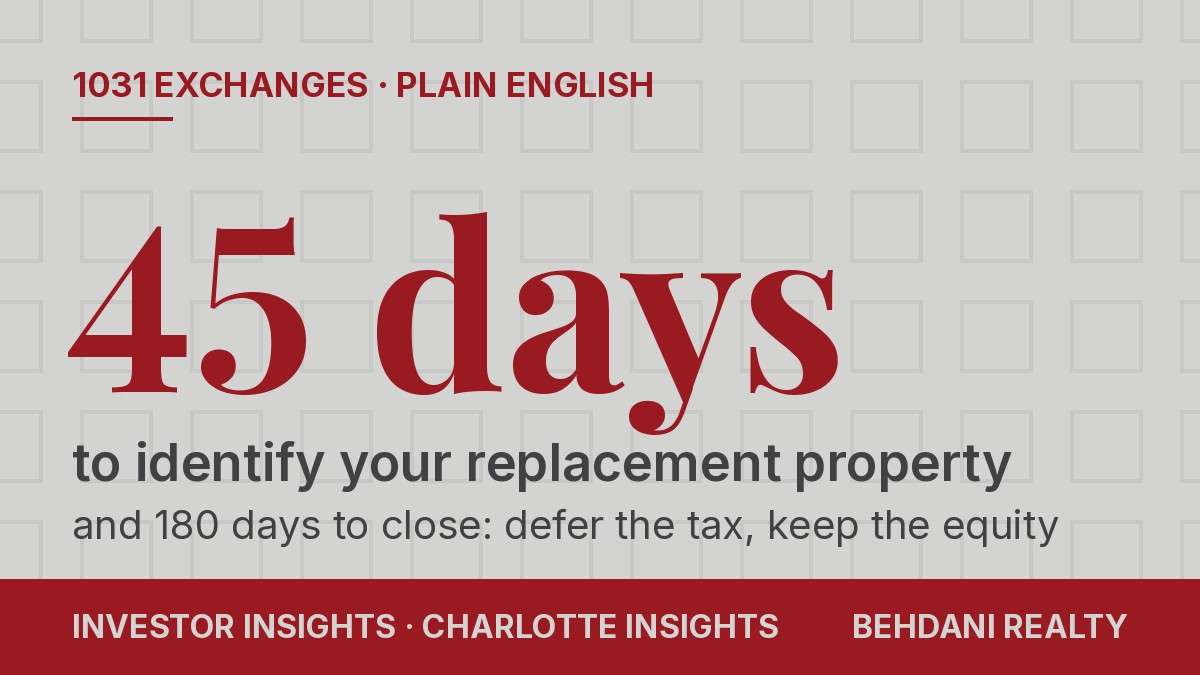
    45 days
    to identify your replacement property
    180 days
    to close on it
    $0
    of sale proceeds you can touch along the way

    What a 1031 exchange is

    • Section 1031 of the tax code lets you defer (not erase) the tax on a gain when you sell real estate held for investment or business use and buy other “like-kind” real estate.
    • Since 2018, only real property qualifies. “Like-kind” is broad: a rental house can be traded for land, a small apartment building or a commercial property.
    • Your own home, and property you buy to fix and flip, don’t qualify.

    The rules that trip people up

    1. Use a qualified intermediary (QI). The sale money goes to the QI, not to you. If you take the cash, the exchange fails.
    2. 45-day identification. Within 45 days of closing the sale, you must identify the replacement property in writing.
    3. 180-day closing. You must close on the replacement within 180 days of the sale (or by your tax return due date, if that’s sooner). Weekends and holidays don’t stretch it.
    4. Buy equal or greater. To defer all of the tax, buy a property worth at least as much and reinvest all of the cash. Any cash or debt reduction you keep (“boot”) is taxable.
    5. Same taxpayer. The name on the sale generally needs to match the name on the purchase.
    6. Report it. You file IRS Form 8824 with your tax return.

    Why it fits Charlotte right now

    • Many owners who bought rentals in Charlotte five to ten years ago have big gains. An exchange lets you move that equity instead of handing part of it to taxes.
    • With more inventory and flat prices, buyers have time to find a good replacement property, which makes the 45-day window less stressful than it was in 2021–2022.
    • Common Charlotte moves: trading a single-family rental for a duplex or small multifamily, swapping an older rental for newer construction, or moving into commercial property for longer leases.
    AMIR’S TAKE
    The deadline that catches people isn’t 180 days, it’s 45. I tell investors to start looking for the replacement before they list the property they’re selling, so they’re not forced into a so-so deal at day 44. Line up your QI and CPA first, then let’s find the right property.
    Planning a 1031 exchange? I can help you find replacement properties in Charlotte and South Carolina on your timeline.

    Talk with Amir

    Get Charlotte news like this every week. The Growth Report comes out Fridays and The Crane Count Wednesdays, both free. Sign up

    Sources: IRS, “Like-kind exchanges: Real estate tax tips” and Form 8824 instructions; Internal Revenue Code Section 1031 as amended by the Tax Cuts and Jobs Act (2017).

    Disclosures: Behdani Realty Company LLC is a licensed real estate brokerage in North Carolina and South Carolina. Behdani Realty does not act as a qualified intermediary and does not give tax advice. This article is general information only. It is not legal, tax, financial or investment advice, and it is not an offer to buy or sell any property. Facts come from the sources listed and can change. Equal Housing Opportunity.
  • Short-Term Rentals in Charlotte and Matthews: The Rules Investors Need to Know

    Short-Term Rentals in Charlotte and Matthews: The Rules Investors Need to Know

    INVESTOR INSIGHTS · NOVEMBER 2026 · 4-MINUTE READ

    Please note: This is general information, not legal or tax advice. Short-term rental rules change and depend on the exact property and zoning, so confirm with the town, the county and your attorney or CPA before you buy.

    Thinking about buying a home to rent on Airbnb or Vrbo around Charlotte? The rules depend a lot on which side of the town line the house sits on. Here is what investors should know about Charlotte and Matthews heading into 2027.

    No permit
    Charlotte has no citywide short-term rental permit or registration
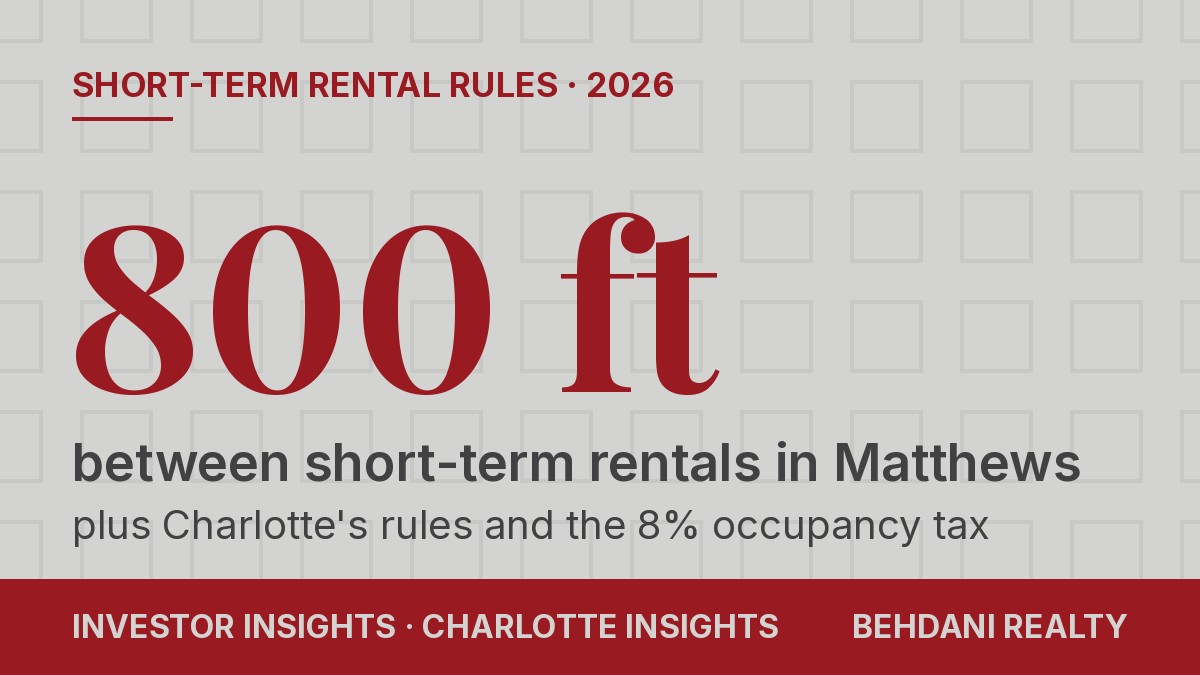
    800 ft
    required between short-term rentals in Matthews
    8%
    occupancy tax on stays in Mecklenburg County

    Charlotte: zoning and nuisance rules, no permit

    • Charlotte drafted short-term rental rules for its new Unified Development Ordinance (spacing between whole-house rentals, parking and a ban on parties), then dropped them in 2022 after a state appeals court struck down Wilmington’s rental registration rules.
    • Today there is no citywide permit, registration or cap. Rentals follow the same zoning, noise, parking and nuisance rules as any home, and enforcement is mostly complaint-driven.
    • HOA rules can be stricter than the city. Many Charlotte HOAs ban or limit rentals under 30 days, so read the covenants before you make an offer.

    Matthews: an annual permit and real limits

    Matthews adopted short-term rental rules in October 2024, and they took effect in November 2024. Key points:

    • An annual zoning permit for every short-term rental. The fee was set at $250 and can be adjusted by the town.
    • Rules treat homestays (the owner or a manager lives on site) differently from whole-house rentals, which are limited to certain zoning districts.
    • Rentals must be at least 800 feet apart.
    • No more than 2 guests per bedroom, and no parties or events.
    • A local operator or manager must be in or next to Mecklenburg County.
    • Rentals that were already operating could keep going but still need the permit. Repeat violations can cost you the permit for a year.

    Taxes every host owes

    • Occupancy tax: 8% in Mecklenburg County (a 6% tax plus a 2% tax), the highest total in North Carolina. Most of it funds the convention center and the NASCAR Hall of Fame, with a share going to the towns.
    • Sales tax: short stays are also subject to North Carolina sales tax.
    • Airbnb and Vrbo collect and pay some of these taxes for bookings made through their sites. Direct bookings are on you, so register with the county and the NC Department of Revenue, and ask your CPA how your platforms handle it.

    Watch Raleigh too

    A 2025 state bill, Senate Bill 291, would limit how far cities and towns can restrict short-term rentals while still allowing permits, occupancy caps and parking limits. It has been sitting in a Senate committee since March 2025 and is not law. If it moves, rules like Matthews’ could change.

    Before you buy: a 5-point check

    1. Confirm the town and zoning district for the exact address. Charlotte, Matthews, Mint Hill and Pineville all have different rules.
    2. Read the HOA covenants for minimum-stay or rental limits.
    3. In Matthews, check the 800-foot spacing against existing permitted rentals before you go under contract.
    4. Run the numbers with the 8% occupancy tax, sales tax, cleaning and platform fees included.
    5. Plan a backup: could it work as a 30-day-plus or long-term rental if the rules change?
    AMIR’S TAKE
    I’ve owned and run short-term rentals in Charlotte and Matthews since 2018, and the rules have changed more in the last two years than in the five before. The best investments still work as a mid-term or long-term rental, so you’re never betting everything on one set of rules. Check the town line and the HOA before you fall in love with a house.
    Looking at a rental property? Send me the address and I’ll estimate short-term and long-term rental income and check the local rules, free.

    Get a free rental estimate

    Get Charlotte news like this every week. The Growth Report comes out Fridays and The Crane Count Wednesdays, both free. Sign up

    Sources: WSOC-TV (May 2, 2022; Oct 17, 2024); The Charlotte Ledger (July 2022); WCNC (2024); Town of Matthews Unified Development Ordinance and short-term rental permit rules (summarized by STR Profit Map, accessed Nov 2026); NC Restaurant & Lodging Association, 2026 North Carolina Occupancy Taxes (July 2026); UNC School of Government bill summary and NC General Assembly, Senate Bill 291 (2025–2026 session; last action Mar 17, 2025); Wake Forest Law Review (Feb 2026).

    Disclosures: Behdani Realty Company LLC is a licensed real estate brokerage in North Carolina and South Carolina. Amir Behdani owns and operates short-term rentals in Charlotte and Matthews. This article is general information only. It is not legal, tax, financial or investment advice, and it is not an offer to buy or sell any property. Rules and taxes change; verify with the Town of Matthews, the City of Charlotte, Mecklenburg County and a qualified attorney or CPA. Equal Housing Opportunity.